
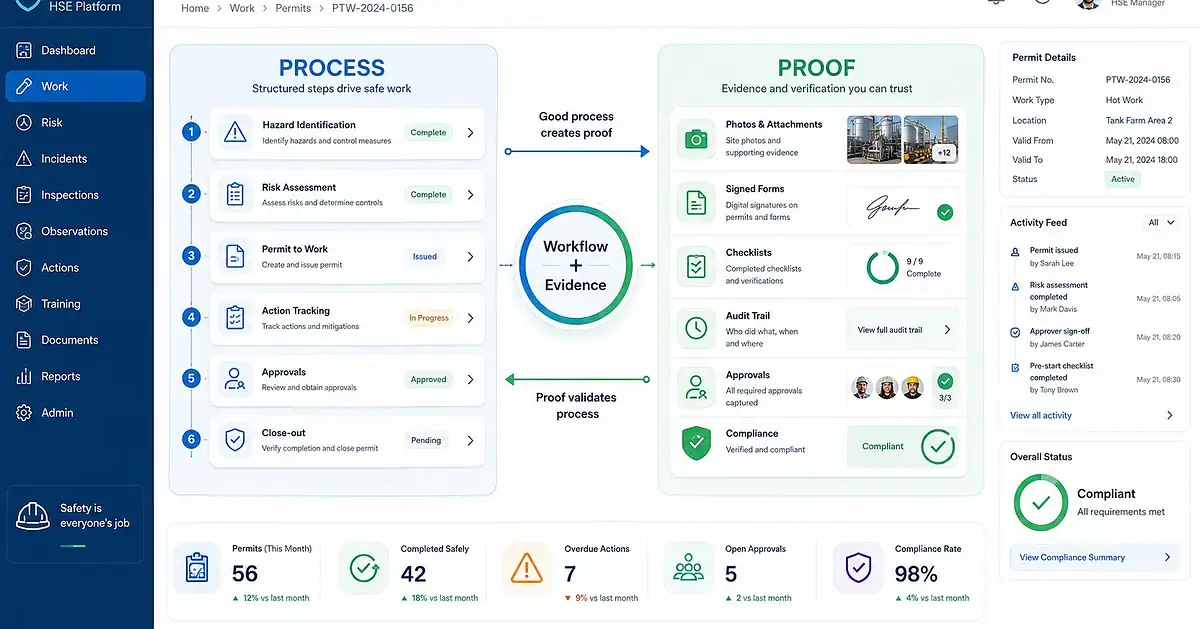
HSE Software built around
PROCESS AND PROOF
When work goes wrong, the first question is always the same: was there a proper process, and can you prove it? Pisys has been helping businesses answer that question since 1988.
Pisys HSE software supports organisations that need clear workflows, accountable ownership and reliable evidence across safety-critical operations.
Our systems are used to manage permits, actions, audits, training scenarios, reporting and operational data where spreadsheets, shared folders and paper records are no longer enough.
Whether you are controlling work on a complex site, closing actions from HAZOPs and audits, or proving that safety-critical processes have been followed, the focus is the same: make the process clear, make ownership visible, and keep an audit trail that stands up to review.
Discuss your HSE software requirements
Core HSE Software
Permit to Work
Managing permits on paper or spreadsheets across a complex site with multiple simultaneous operations.
Permit to Work softwareProcess Safty Action Tracking
Manage actions from studies, audits, risk assessments, incidents etc. with configurable workflow and full auditability
Action Tracking softwareSafety-critical training and assurance
Operator Training Simulators
Allows OPITO-approved MEMIR training for control room operators on FPSO, semi-submersible, jack-up or high voltage environments.
OPs Training SimulatorRelated engineering and operational tools
Catenary Analysis
Accurate mooring system design and analysis for floating offshore structures.
WinCAT Catenary Analysis softwareData Acquisition
Connecting industrial sensors and control systems to your HSE management workflow in real time.
IOSPy Data Acquisition softwareGyro Calibration
Powerful and field-proven calibration of a range of subsea gyros
GYROCAL Calibration softwareQuestions worth asking any HSE software supplier
Choosing HSE software is not just about features. The system may need to support safety-critical processes, provide evidence during audits, and fit the way your organisation actually works.
Before choosing a supplier, it is worth asking:
- Does the system provide a clear audit trail of actions, approvals and changes?
- Can workflows, permissions and forms be configured around your existing processes?
- How are overdue actions, permit stages or approvals highlighted and escalated?
- Can the system support multiple sites, teams or business units?
- What support is available during implementation and after go-live?
- How is data protected, backed up and controlled?
- Can reports be produced for managers, auditors and operational teams?
GET IN TOUCH
Looking for HSE software that fits your existing processes?
Pisys can help you manage permits, actions, training and operational workflows with systems designed for auditability, security and long-term support.
Speak to us about your requirements and we can help identify which Pisys system is the best fit.
(We’ll only use your details to respond to your enquiry.)
Frequently Asked Questions
HSE software helps organisations manage health, safety and environmental processes in a more structured and auditable way. It can be used to control work, manage actions, record evidence, assign responsibility and track whether safety-critical tasks have been completed.
For many organisations, HSE software replaces spreadsheets, paper forms and shared folders with clearer workflows, ownership, deadlines and reporting.
Good HSE software should make it clear what needs to happen, who is responsible, when it is due and what evidence is required before a process can be closed.
Important features often include configurable workflows, audit trails, user permissions, reporting, notifications, document links, approval stages and a clear history of decisions and changes.
Yes. Permit to Work is one of the most common examples of HSE software, especially in higher-risk industries or complex operational environments.
A Permit to Work system helps control non-routine or hazardous work by making sure the task, location, risks, precautions, isolations, approvals and handbacks are clearly recorded before work starts and when it is completed.
HSE software can help organisations track actions from audits, inspections, incidents, risk assessments, HAZOPs, HAZIDs and other studies.
Instead of relying on spreadsheets, actions can be assigned to owners, given deadlines, escalated when overdue and closed only when suitable evidence has been provided. This gives managers better visibility and creates a stronger audit trail.
Auditability is important because HSE processes often need to be reviewed after an incident, inspection, audit or management review.
A good system should show who did what, when it was done, what changed, who approved it and what evidence was used. This helps organisations demonstrate that their safety processes are being followed rather than simply documented.