

Published: 29 April 2026
Updated: 13 July 2026
OPITO published its updated Delivery and Assessment Policy in March 2026. For Major Emergency Management training centres, one section stands out.
Under the policy, OPITO Products have been categorised according to the type of learning and assessment being conducted, and the category determines whether remote delivery is permitted:
- Category B covers products whose practical outcomes can be delivered and assessed in a classroom environment or by using simulation technology. Centres are not required to have a physical training facility to deliver and assess these Products remotely.
- OPITO 7228 - Major Emergency Management Initial Response (MEMIR) Training
OPITO 7228 has been classified as Category B, course delivery and appraisal can be done remotely.
- Category C covers products that can be delivered remotely at an approved off-site location. Some Category C Products require the Nominated Assessor to be present at the training/assessment location.
Several of the most widely delivered MEM products appear explicitly in the policy:
- OPITO 9004 — Control Room Operator Emergency Response Standard
- OPITO 9244 — Emergency Coordinator for Renewable Energy (Wind)
- OPITO 7025 — OIM Controlling Emergencies
- OPITO 7031 — Onshore Control Room Operator Emergency Response Standard
All four are confirmed as eligible for remote delivery under Category C. For Category B products, the policy states that practical outcomes can be delivered and assessed remotely "provided suitable remote assessment processes are in place" and that "Centres are not required to have a physical training facility to deliver and assess these Products remotely."
What this means in practice
For training centres delivering MEMIR, OIM and Control Room Operator courses, the policy removes a significant barrier to remote and cloud-based delivery. Under the previous framework, centres needed to demonstrate physical premises and equipment for practical outcomes. The updated policy explicitly accommodates delivery through simulation technology, meaning a cloud-based simulator accessed by students remotely can satisfy the practical outcome requirements, provided the assessment processes meet OPITO's documented standards.
The implications are significant for three groups:
Training centres with existing Pisys simulators.
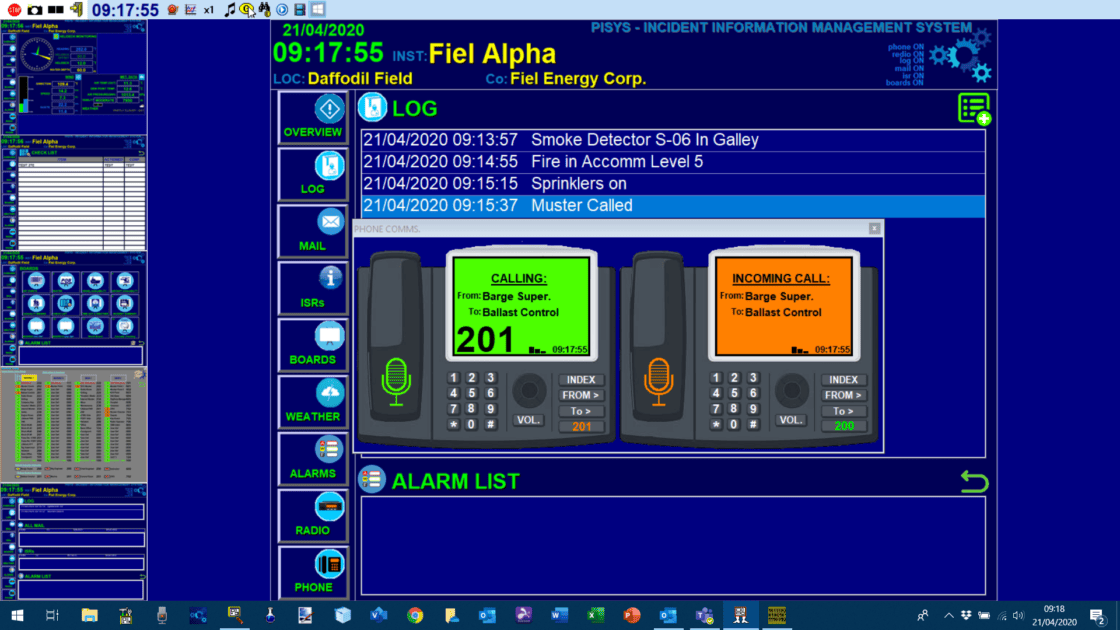
Centres already running Pisys OTS systems on-site can now extend their delivery to remote students without duplicating hardware. A student in a different country can access the same simulator environment, complete the same practical scenarios and be assessed against the same outcomes from any device, via a browser. Click here to see how the Pisys MEM/IR simulators are available remotely
Centres considering simulator investment.
The policy confirms that a physical simulation facility is not a prerequisite for remote delivery of Category B and C products. A cloud-based simulator subscription enables an approved centre to deliver practical MEM outcomes to geographically distributed delegates without significant capital investment in hardware.
Operators and employers.
For organisations whose staff need MEMIR or OIM certification but are based across multiple international locations, the policy creates a clearer pathway for remote training without requiring all delegates to travel to a single approved centre.
OPITO's requirements for remote delivery
The policy sets clear requirements that centres must meet for remote practical delivery. Centres must have documented processes for verifying learner identity, assessment records that accurately reference all outcomes, and training and assessment procedures that detail how practical outcomes will be evaluated consistently. For the first remote delivery of a new product, or when new delivery methods are adopted, centres must complete a remote approval form in the OPITO HUB and receive approval before practical learning or assessment takes place.
This is a formal framework for delivering the same outcomes through a different method. The assessment rigour remains the same; what changes is the flexibility of the delivery environment.
Cloud-based simulation and the Pisys OTS
The Pisys Operations Training Simulator has been delivering remote MEM training since before the pandemic. FMTC, which operates training centres across Amsterdam, Louisiana, Dunkirk, Zeebrugge, Marseille and Ras Tanura, uses the Pisys cloud simulator to deliver courses to students across Australia, the USA, India, Egypt, Saudi Arabia and Europe, other customers include the Arab Academy for Science, Technology and Maritime Transport in Alexandria which adopted the cloud-based system during COVID and has continued using it alongside their on-site suite ever since. For more context around the use of simulators for Operations Training read this article.
The OPITO March 2026 policy formally validates this approach. For centres that have been considering the move to cloud-based simulation, or operators looking for more flexible training pathways for their teams, the policy removes the ambiguity that previously existed around remote practical delivery.
For more information about the Pisys cloud-based Operations Training Simulator, including how it supports OPITO 7025, 7228, 9004 and 9244 delivery, visit our OTS product page. To understand how other training centres are already using the system, see our case studies.
Read a detailed description of the technical and commercial considerations around our cloud platform