

Published: 10 April 2026
Updated: 11 July 2026
The catenary effect is one of the most fundamental principles in offshore engineering. Whether you work in mooring operations, anchor handling, subsea installation or offshore wind, understanding how a suspended cable or chain behaves under its own weight is essential to working safely and making sound engineering decisions.
What Is the Catenary Effect?
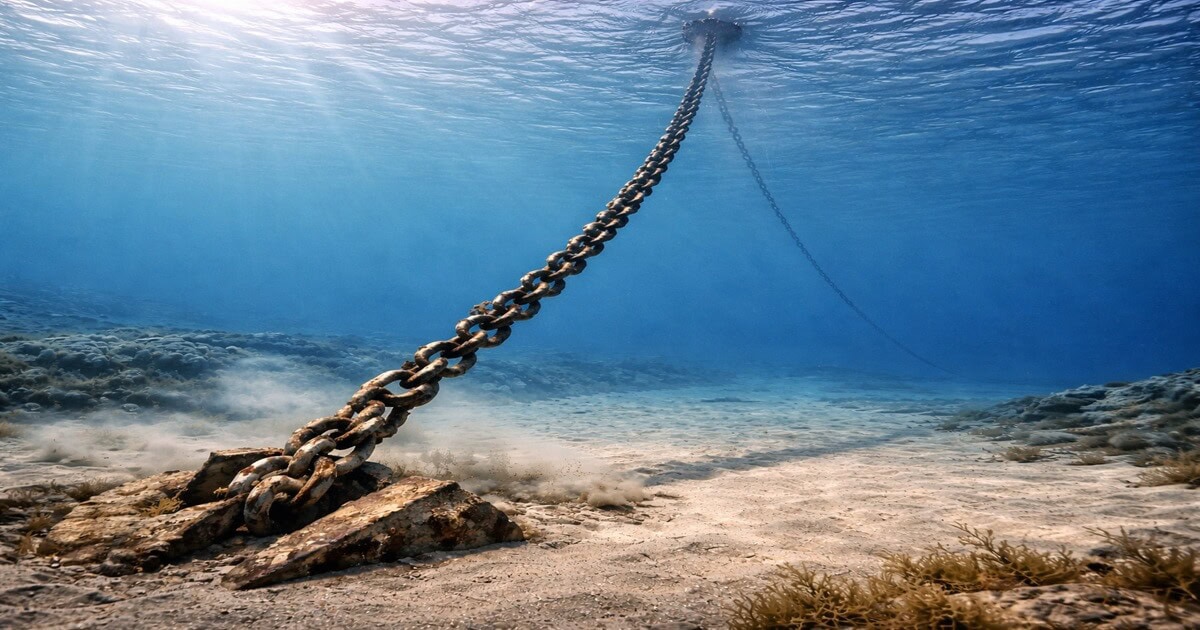
When a flexible cable, chain or rope is suspended between two points and left to hang freely, it forms a smooth curve under its own weight. This curve is called a catenary. It looks similar to a parabola but is mathematically distinct, described by a hyperbolic cosine function.
The shape of the catenary depends on two things: the weight of the cable per unit length, and the horizontal tension at the lowest point of the curve. A heavier cable produces a tighter, steeper curve. A lighter cable with the same horizontal tension produces a shallower, more gently curving shape. As more cable is paid out, the curve deepens. As the two end points are pulled further apart horizontally, the curve flattens and tension rises.
This predictable relationship between geometry and load is what makes the catenary effect so useful in offshore engineering.
Why It Matters Offshore
Offshore, a suspended cable is never just hanging there. It is carrying load, interacting with the seabed, restraining a vessel or transmitting force to an anchor. The catenary effect governs all of these behaviours.
For mooring systems, the catenary shape of a mooring line is what gives a catenary mooring its compliance. As a vessel offsets from its anchor point, the curve in the line changes shape before the line begins to stretch. This geometric response absorbs movement gradually, reducing shock loads on the vessel, the mooring hardware and the anchor. It is why catenary moorings are preferred over taut-leg systems in many shallow and intermediate water applications.
The catenary effect also determines where a mooring line first touches the seabed, known as the touchdown point. This matters for clearance over subsea pipelines and other infrastructure. Move the vessel, and the touchdown point shifts. Pay out more line, and it shifts again. Understanding this relationship is essential for safe operations near subsea assets.
Tension distribution along the line follows directly from the catenary shape. Tension is lowest at the lowest point of the curve and increases toward both ends. At the fairlead, total tension includes both a horizontal component and a vertical component equal to the weight of the suspended portion of the line. The catenary effect is what connects the geometry you can see on a plot to the loads that determine whether your equipment is within safe limits.
Where the Catenary Effect Appears in Offshore Work
The same principle applies across a wide range of offshore operations.
In anchor handling, the catenary shape of the anchor chain determines how much cable must be paid out to achieve a target horizontal load without lifting the anchor off the seabed. In umbilical and flexible riser management, catenary behaviour governs how the line responds to vessel motion and whether compression can develop at the touchdown point. In cable lay and recovery, the catenary determines the tension at the vessel end and the angle at which the cable meets the seabed.
In offshore wind, as turbines move into deeper water and floating foundations become more common, catenary mooring systems are increasingly important. The same principles that govern a simple anchor chain govern a multi-line spread mooring for a floating wind turbine, though the engineering complexity is considerably greater.
The Limits of Simple Catenary Thinking
A textbook catenary assumes a single uniform cable with constant weight per unit length throughout its length. Real offshore lines rarely meet this assumption. A typical mooring line might consist of bottom chain, a mid-section of wire rope and a top pennant, each with different weights and mechanical properties. This changes the shape of the curve, the location of the touchdown point and the distribution of loads in ways that a simple uniform catenary cannot capture accurately.
Seabed interaction adds further complexity. When part of the line rests on the seabed, the geometry changes and friction affects how the line responds to changes in vessel position or payout. Buoyancy elements positioned along the line alter the curve further.
For anything beyond a simple preliminary estimate, these real-world factors need to be accounted for properly. That is where purpose-built catenary analysis software such as WinCAT adds value — handling multi-section lines, seabed interaction, buoyancy and multiple what-if scenarios in a structured and repeatable way.