


Jack-up punch-through is one of the most serious hazards in offshore drilling operations. It occurs rapidly, often with little warning, and the consequences for crew safety and asset integrity can be severe. Understanding what causes punch-through, how seabed conditions influence the risk, and how crews can be trained to respond effectively are all critical questions for anyone involved in jack-up operations.
What Is Jack-Up Punch-Through?
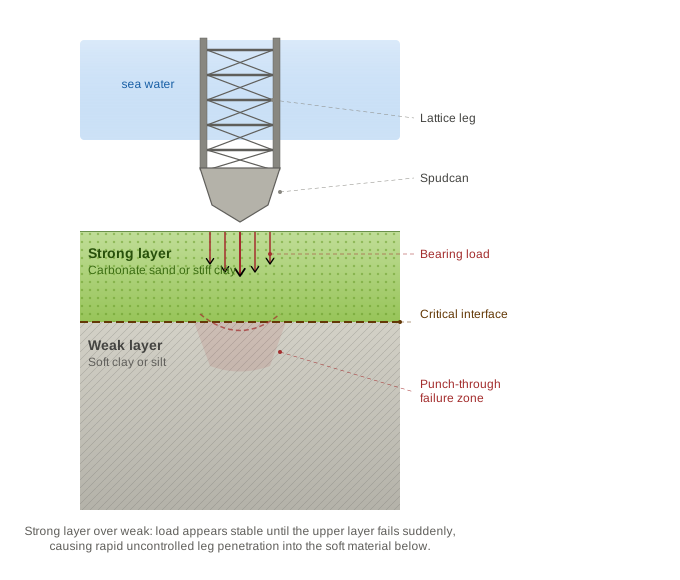
A jack-up rig is supported on the seabed by three or four legs, each fitted with a spudcan at its base. During the preloading and jacking process, the spudcans are driven into the seabed to achieve a stable, load-bearing foundation. Punch-through occurs when the spudcan suddenly penetrates beyond its intended depth because the soil beneath it cannot sustain the applied load.
Unlike gradual settlement, punch-through is an abrupt event. The leg can drop by several metres in a matter of seconds, causing the rig to list, placing extreme stress on the hull and leg structures, and creating immediate risk to personnel. In severe cases, punch-through has led to the total loss of a rig.
Seabed Lithology and Its Effect on Punch-Through Risk
The geology of the seabed is the primary factor governing punch-through risk. Not all seabeds behave the same way, and understanding soil composition is essential to assessing and managing the hazard.
The most dangerous geological condition is an interbedded sequence in which a relatively strong soil layer overlies a weaker one. During preloading, the spudcan bears on the stronger upper layer and appears stable. As load increases, the upper layer fails and the spudcan punches through into the weaker material below, often with very little warning. This scenario is common in areas where carbonate sands or stiff clays overlie soft clays or silts.
Carbonate soils present particular challenges. They are found extensively in the Middle East, South East Asia and Australia, and their mechanical behaviour differs significantly from siliciclastic soils. Carbonate sands can appear competent under initial loading but crush and collapse at higher stresses, making punch-through prediction more difficult.
Soft clays and silts, common in the North Sea and West Africa, can also create punch-through conditions, particularly where the strength profile is variable or where drainage conditions affect how the soil responds to rapid loading.
Site investigation data, including cone penetration tests and soil borings, is used to assess punch-through risk before a rig is positioned. However, site investigation can only sample a limited area and depth, and spatial variability in soil conditions means that uncertainty always remains. Even with thorough geotechnical data, punch-through cannot be entirely eliminated as a risk, which is why crew training and response capability are essential.
Why Punch-Through Is One of the Highest-Risk Events in Jack-Up Operations
The danger of punch-through lies not only in the event itself but in the speed at which it unfolds. A leg drop of several metres can occur in seconds, giving the crew very little time to react. The sudden shift in load distribution can cause the rig to list rapidly, potentially sliding the remaining legs across the seabed and placing the hull at risk of contact with the water surface.
Secondary consequences include structural damage to the leg and rack system, loss of control of the wellbore if drilling is in progress, and risk to personnel from falling objects, flooding and evacuation in adverse conditions. The combination of speed, structural complexity and the potential for rapid escalation makes punch-through uniquely demanding from a training perspective.
The Challenge of Training for Punch-Through
Punch-through can't be safely rehearsed on a live rig. The event is destructive by nature and the load levels involved during preloading cannot be manipulated to create controlled training scenarios without genuine risk to the asset and crew.
At the same time, punch-through is a low-frequency event. Many experienced jack-up crews will never encounter it in their careers. When it does occur, the response window is extremely short and the correct sequence of actions must be executed under significant time pressure and stress.
Traditional training methods can explain what punch-through is and describe the correct procedures. They cannot replicate the sensory cues, the rate of change of leg load indicators, the urgency of real-time decision-making or the team communication demands that characterise an actual event. This is precisely where simulator training adds value that no other training method can provide.
How the Pisys Jack-Up Simulator Addresses Punch-Through Training
The Pisys jack-up training simulator replicates the control room environment of a jack-up rig, including the leg load monitoring systems, jacking controls, ballast management interfaces and alarm systems that crews rely on during preloading and jacking operations.
Instructors can configure punch-through scenarios based on specific soil profiles, including interbedded conditions that reflect high-risk geological settings. Trainees monitor leg load and penetration data in real time and must identify the early indicators of impending punch-through before the event occurs. When punch-through is initiated, the simulator responds dynamically, requiring the crew to manage list, redistribute ballast, respond to alarms and communicate across the team under time pressure.
Sessions can be paused for debrief, replayed to review decision points, and stored for competence assessment purposes. The cloud-based platform means that training can be delivered remotely, allowing crews to prepare for specific campaigns or locations without travelling to a training centre. For more detail on the full range of jack-up training scenarios available, visit the Pisys jack-up training simulator page.
What Crews Learn from Punch-Through Simulation
Repeated exposure to punch-through scenarios in a simulator environment develops several critical competencies. Crews become familiar with the normal behaviour of leg load indicators during preloading and learn to recognise the subtle deviations that can precede punch-through. They practise the correct sequence of emergency actions under realistic time pressure, building the muscle memory and decision-making patterns that are difficult to acquire through classroom instruction alone.
Communication and coordination are also developed. Punch-through demands clear, rapid information exchange between the driller, ballast control operator and offshore installation manager. Simulator exercises allow teams to practise these interactions in a realistic setting and identify weaknesses before they matter in the field.
Related Training Scenarios
Punch-through is one of several high-consequence scenarios covered by the Pisys jack-up simulator. The platform also supports training for jacking operations, preload management, rig move procedures and MEMIR emergency response. Taken together, these scenarios provide a comprehensive training programme for jack-up crews operating in any environment. Further reading on the role of simulation in offshore training is available in the simulation-based training in the energy sector overview.