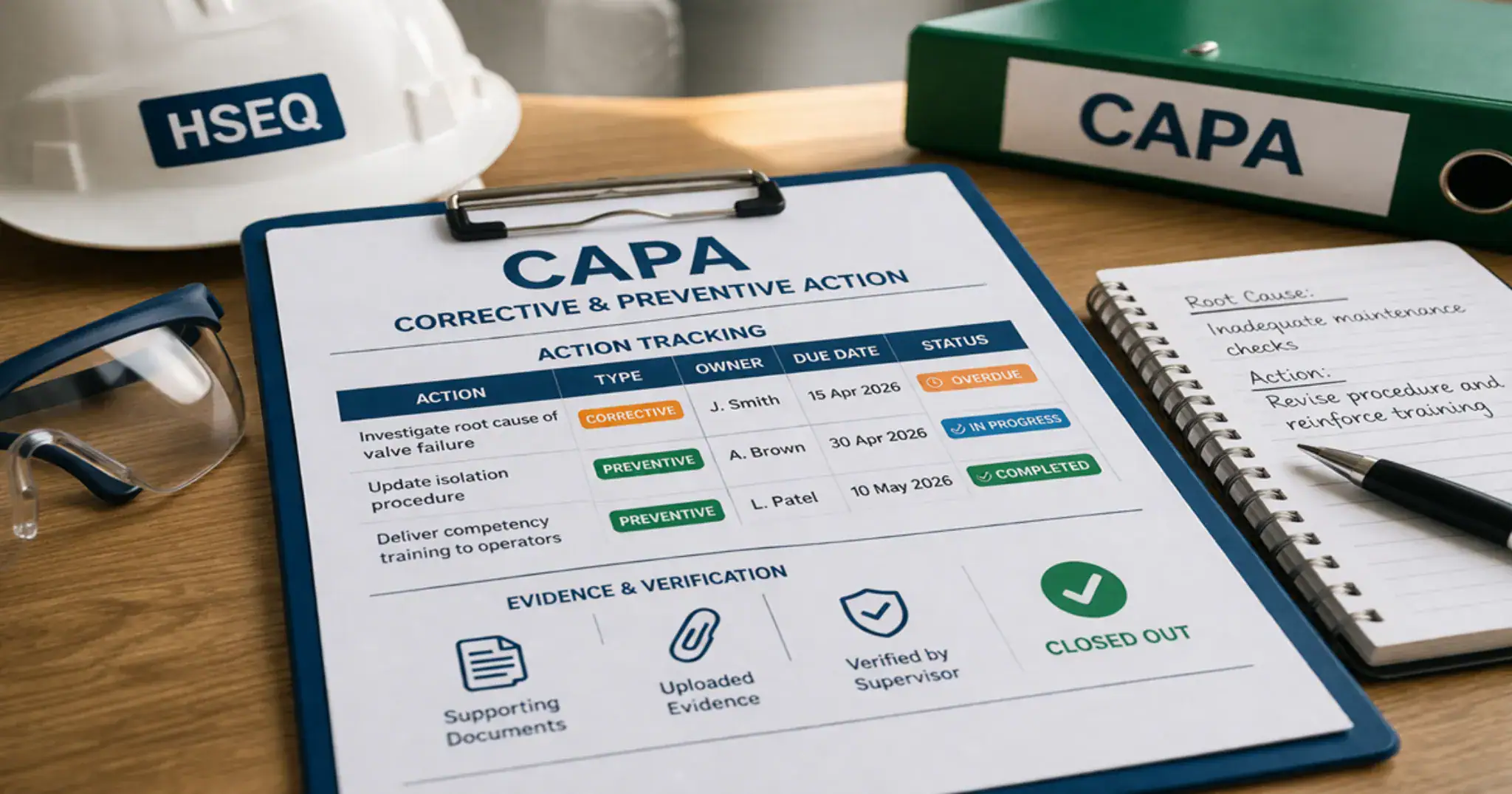

CAPA action tracking is the process of managing corrective and preventive actions so they are assigned, monitored, evidenced, and properly closed out. In practice, CAPA only works when actions are visible, ownership is clear, and completion is more than a box-ticking exercise. For a broader overview, read our guide to action tracking and action management in business.
What does CAPA mean?
CAPA stands for Corrective and Preventive Action.
A corrective action is taken to address the cause of a problem that has already happened.
A preventive action is intended to stop a similar problem from happening in future.
In high-risk and regulated environments, CAPA is often used to manage findings from:
- audits
- inspections
- incidents
- non-conformances
- process safety reviews
- compliance assessments
What is the Difference between Corrective and Preventive action?
It's simple but important:
Corrective action
Corrective action responds to an issue that has already occurred.
Its purpose is to address the cause and reduce the chance of recurrence.
Examples:
- fixing a weakness identified during an audit
- addressing the cause of an incident
- closing a gap found during an inspection
Preventive action
Preventive action is taken before an issue happens again, or before a similar issue appears elsewhere.
Examples:
- changing a procedure to avoid repeated errors
- improving training before the same failure occurs on another site
- strengthening controls after identifying a recurring risk trend
In practice, both need to be tracked with the same level of discipline.
What Is Corrective Action Tracking?
Corrective action tracking is the process of managing actions raised in response to an identified problem, incident, failure or non-conformance.
Once an appropriate action has been agreed, it must be assigned to an owner, given a deadline, monitored, supported by evidence and reviewed before closure.
Corrective action tracking is therefore an important part of CAPA management, although it can also be used independently where the focus is on addressing issues that have already occurred.
What is CAPA action tracking?
CAPA action tracking is the system used to make sure corrective and preventive actions are followed through properly.
That usually means tracking:
- what the issue was
- what action has been agreed
- who owns it
- when it is due
- what evidence is required
- whether it has been verified
- whether it is truly ready to close
With that structure, CAPA becomes a controlled improvement process.
Why CAPA often fails in spreadsheets and email
Many organisations start by tracking CAPA in spreadsheets, email threads, or local documents. That may work at small scale, but it often breaks down as complexity increases.
Common problems include:
No central visibility
Different teams maintain their own trackers, making it hard to see the full picture.
Unclear ownership
Actions are raised, but no one is clearly accountable for delivery.
Weak deadline control
Overdue actions are easy to miss when reminders and escalation are manual.
Poor evidence management
Actions get marked complete without proper proof or verification. This is particularly easy when actions are tracked in spreadsheets or Word documents, where there may be nothing to prevent an action being marked complete without supporting evidence.
Inconsistent close-out
Different people apply different standards for what “done” means.
Limited reporting
Leadership can struggle to see which actions are overdue, which are high risk, and where bottlenecks are forming.
In regulated or high-risk environments, these gaps create more than inefficiency. They create risk.
What Should CAPA and Corrective Action Tracking Software Include?
CAPA and corrective action tracking software should do more than maintain a list of outstanding actions. It should provide the controls needed to manage ownership, deadlines, evidence, review and verified closure.
Effective CAPA and corrective action tracking software should include:
Clear ownership
Every action has a named owner who is responsible for delivery.
Defined deadlines
Due dates are visible, realistic, and actively monitored.
Meaningful action descriptions
The required outcome is clear, not vague.
Evidence of completion
There is proof that the action has actually been carried out.
Verification
Someone checks whether the action is complete and effective before it is closed. Read our article on action verification.
Visibility and escalation
Overdue or high-risk actions can be seen and escalated quickly.
Transparent audit trail
When changes are made, it should be easy to see what changed, when it changed and who made the change, without having to cross-reference multiple sources.
Consistent close-out standards
The organisation has a clear view of what must happen before an action is considered closed.
This is where many CAPA processes succeed or fail. For more guidance, read our article on managing actions through to verified closure.
Where CAPA fits in audits, incidents, and process safety
CAPA is not usually a standalone activity. It sits behind other important operational and compliance processes.
Audits
Audit findings often generate corrective actions that need ownership, timescales, and evidence before they are closed.
Incidents
Incident investigations often result in actions that are meant to address root causes and prevent recurrence.
Inspections
Inspection findings may identify gaps that need to be corrected quickly and tracked to completion.
Process safety reviews
HAZOPs, SIL reviews, and other process safety activities often raise actions that are critical to risk reduction.
In all of these cases, the quality of action tracking has a direct effect on whether the original process leads to real improvement. Read our article on process safety action management.
What should be required before an action is closed?
One of the biggest weaknesses in CAPA is premature close-out.
An action should not usually be marked closed just because someone says it is finished. Good close-out should require:
- confirmation that the work is complete
- supporting evidence where appropriate
- review by the right person
- confidence that the action achieved its intended purpose
In most cases, the real question is not “has the task been done?” but “has the issue been addressed effectively?”
That distinction matters.
When does CAPA need software?
Some organisations can manage a small CAPA workload manually. But software becomes far more useful when actions come from multiple sources or involve multiple stakeholders.
That is especially true when you need to manage:
- audits and inspections across several sites
- incident follow-up across teams
- process safety actions with long timescales
- overdue actions and escalation
- evidence and verification
- reporting for leadership, compliance, or regulators
At that point, CAPA action tracking needs to be treated as a control system rather than an admin task.
Final thoughts
CAPA action tracking is what turns corrective and preventive actions into a controlled process rather than a loose list of follow-ups. When ownership is clear, evidence is visible, and close-out is properly verified, organisations are far more likely to turn findings into real improvement.
In high-risk environments, that matters. Its real value lies not simply in recording actions, but in ensuring they are completed properly and lead to meaningful improvement or risk reduction.
Pisys Action Tracker provides a centralised, cloud-based system for managing corrective and preventive actions. It supports ownership, deadlines, reminders, evidence, review stages, audit trails and controlled close-out.