

Published: 28 April 2026
Updated: 11 July 2026
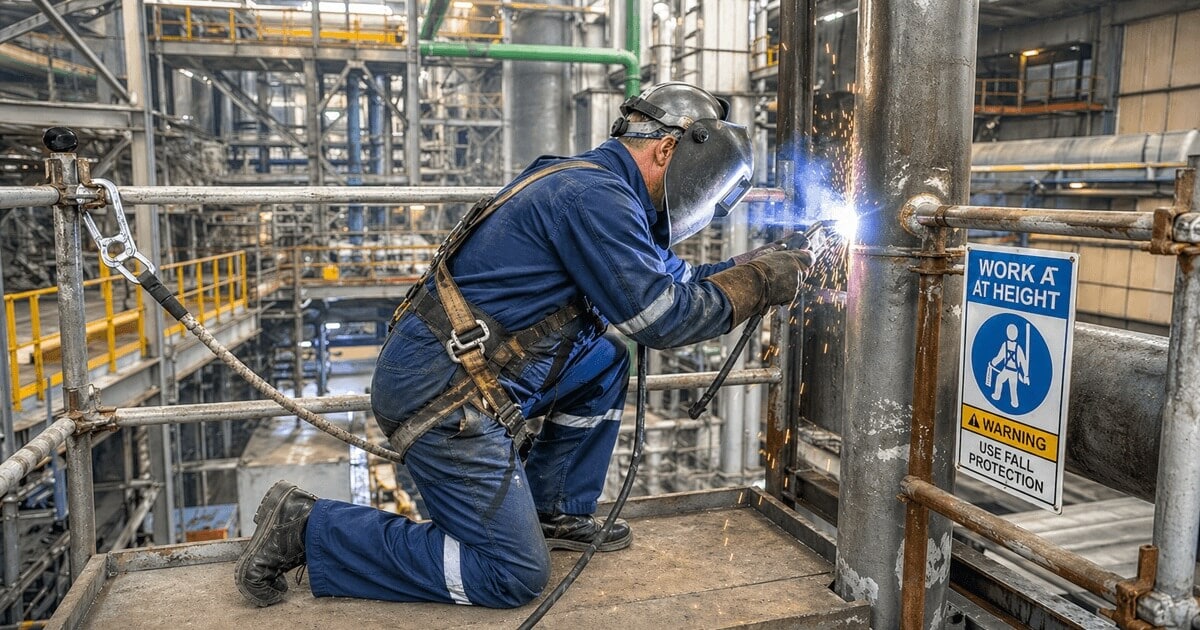
Working at height remains one of the leading causes of fatal and serious injury in the UK workplace. The risks are well understood, the legislation is clear, and the controls are established. Yet incidents continue to happen, often because the planning was inadequate, the controls were assumed rather than verified, or the rescue arrangements were not thought through in advance.
A work at height permit is not a bureaucratic exercise. It is the mechanism that forces the right questions to be answered before anyone leaves the ground. For a broader overview of the permit types used in high-risk work, see our guide to types of permit to work.
What counts as working at height
Under the Work at Height Regulations 2005, working at height means working in any place where, if precautions were not taken, a person could fall a distance liable to cause personal injury. This includes work above ground level, but also work at ground level adjacent to an opening or hole, and work below ground level.
Height is not defined by a minimum distance. A fall from one metre can be fatal depending on how the person lands and what they land on. The permit process applies to the risk, not the measurement.
When a work at height permit is required
Not every task at height requires a formal permit. Routine tasks in permanent, well-maintained workplaces with fixed protection in place may be managed under standard operating procedures. A permit is typically required when:
- The work involves temporary access equipment such as scaffolding, mobile elevated work platforms (MEWPs), ladders for non-routine tasks, or roof access.
- The work is non-routine or infrequent, meaning the hazards have not been assessed as part of a standing procedure.
- The environment introduces additional hazards, including fragile surfaces, proximity to overhead services, adverse weather, or restricted access.
- Contractors are involved and their competence and equipment need to be formally verified before work begins.
The principle is that a permit is required when routine controls are not sufficient and the consequences of getting it wrong are serious.
What a work at height permit must cover
The permit should address the following in sequence:
Description of the work
The exact task, the location, the personnel involved and the time window for which the permit is valid. Vague descriptions like "roof maintenance" are not adequate. The permit should be specific enough that anyone reading it can understand exactly where work is taking place and what is being done.
Equipment to be used
The type of access equipment, its condition, its inspection status and whether it is appropriate for the task and the environment. A MEWP that is suitable for a flat concrete surface may not be suitable for uneven ground or a surface with limited load-bearing capacity.
Hazard identification
Beyond the fall hazard itself, the permit needs to consider: overhead services and obstructions; fragile or unverified surfaces; proximity to edges, openings or skylights; weather conditions at the time of work; other activities taking place nearby that could introduce hazards; and the risk of falling objects to people below.
Controls and precautions
Specific measures aligned to the hazards identified. These may include: edge protection, barriers or covers for openings; exclusion zones below the work area; fall arrest or restraint equipment with anchor points verified before use; equipment inspection records; and restrictions on working in adverse weather conditions.
Competency verification
Confirmation that everyone working at height has the appropriate training and certification for the equipment being used. MEWPs, scaffolding erection and inspection, and rope access all have specific competency requirements. The permit is the point at which those competencies should be checked, not assumed.
Rescue plan
This is the most commonly omitted element of work at height planning. What happens if someone becomes incapacitated while working at height? Who is responsible for the rescue? What equipment is available? Has the rescue method been thought through for the specific location and access equipment? A rescue plan does not need to be complex, but it must exist and must be communicated to everyone involved before work starts.
Authorisation
Sign-off from a competent person confirming that all the above have been addressed and that conditions are safe for work to proceed. The permit is only valid for the specified period and must be re-evaluated if conditions change.
Close-out
Confirmation that work is complete, equipment has been removed or made safe, the area is clear, and no hazards remain. For roof work in particular, this should include a check that no materials, tools or waste have been left behind.
Work at height permit checklist
Use this as a practical reference when raising a work at height permit:
- Work description : task, location, personnel, time window
- Access equipment : type, inspection status, suitability for surface and conditions
- Hazards : edges, openings, fragile surfaces, overhead services, falling objects, other activities nearby
- Controls : edge protection, exclusion zones, fall arrest equipment, anchor point verification
- Competency : training and certification confirmed for equipment type
- Rescue plan : method, responsible person, equipment available, communicated to all
- Authorisation : competent person sign-off, permit period confirmed
- Close-out : work complete, area clear, equipment removed or made safe
For a downloadable reference, you can use our work at height permit template.
The role of a digital PTW system
A digital permit to work system strengthens work at height control in several ways that paper cannot replicate.
Competency checks can be automated. Before a permit is issued to a contractor or employee for work at height, the system can verify that their training certificates are current and appropriate for the equipment being used. If a certificate has expired, the system flags it before the permit is issued rather than after the work has started.
Rescue plans can be attached directly to the permit. Rather than a verbal briefing that may or may not happen, the rescue plan is a required document that must be present before authorisation is granted.
Real-time visibility of active permits means supervisors can see where work at height is taking place across a site at any given moment. This is particularly important for SIMOPS management — if a work at height task is happening directly above another work area, that conflict needs to be visible before either permit is issued. Our post on SIMOPS and PTW covers this in detail.
Audit trails are complete and instant. Every approval, suspension and close-out is logged. For organisations subject to HSE inspection or insurance audit, this transforms what would otherwise be a search through paper records into a structured digital report.
For more on how a digital permit to work system handles work at height and other permit types within a single configurable platform, see our permit to work system. To understand the full PTW framework these permits sit within, our guide to permit to work systems covers the detail.