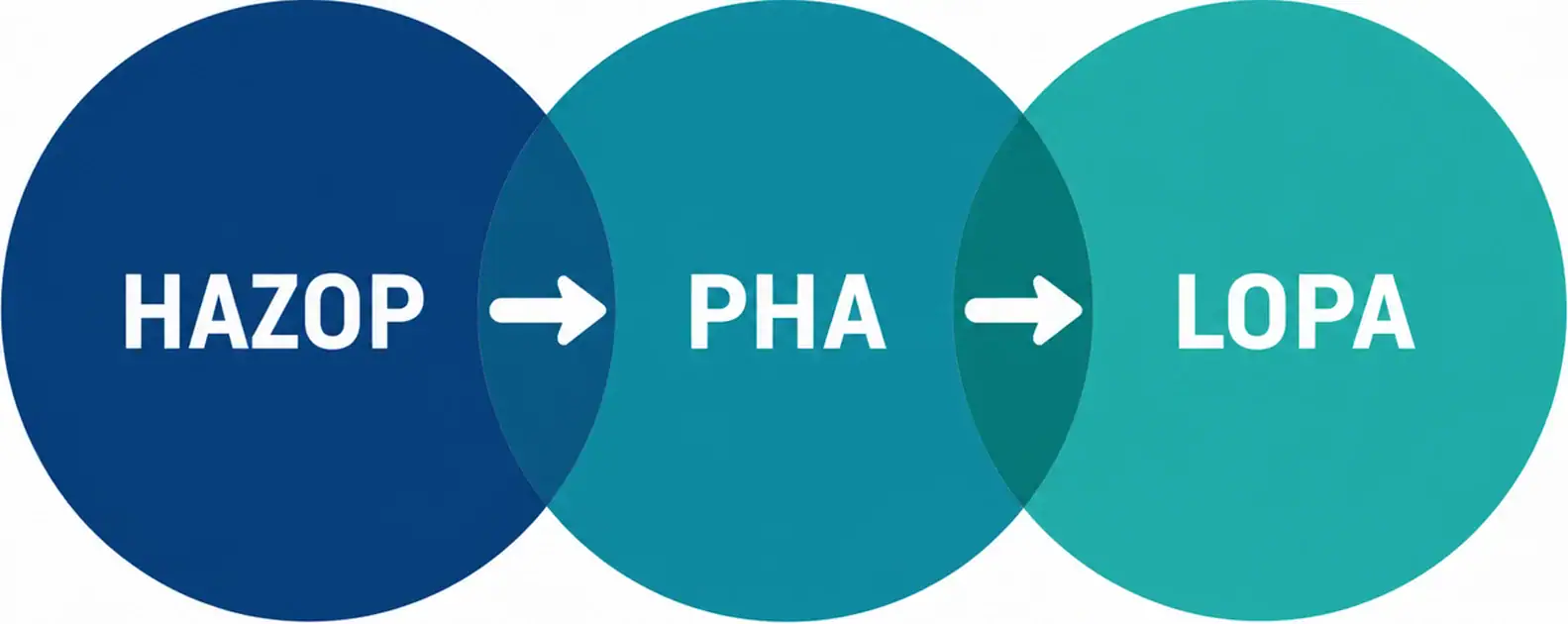

All three approaches have a common goal of ensuring safety and reliability in industrial processes and each has unique features, methodologies, and applications. Let's look at each in turn:
HAZOP
HAZOP, or Hazard and Operability Study, is a structured and systematic technique used to identify potential hazards and operability problems within a process. It focuses on deviations from the design intent and examines the causes and consequences of these deviations. Read about the differences between HAZOP and HAZID studies.
HAZOP Methodology
Team-Based Approach
HAZOP involves a multidisciplinary team, including process engineers, operators, safety professionals, and other relevant stakeholders.
Guide Words
The study uses predefined guide words (e.g., “no,” “more,” “less,” “as well as”) to systematically explore potential deviations from normal operations.
Nodes
The process is divided into manageable sections called nodes. Each node is examined for deviations using the guide words.
Deviations and Consequences
For each deviation identified, the team assesses potential causes and consequences and considers existing safeguards, suggesting additional measures if necessary.
HAZOP Applications
HAZOP is widely used in industries such as chemical processing, pharmaceuticals, oil and gas, and power generation. It is typically conducted during the design phase of a new process or when significant modifications are made to an existing process.
HAZOP Strengths
- Provides a thorough examination of potential hazards and operability issues.
- Encourages teamwork and diverse perspectives.
- Identifies both safety and operational problems.
HAZOP Limitations
- Time-consuming and resource-intensive.
- May become unwieldy for very large and complex processes.
- Relies heavily on the experience and expertise of the team.
PHA
Process Hazard Analysis (PHA) is a broader term encompassing various methodologies used to identify and analyse potential hazards in industrial processes. It includes several techniques, such as HAZOP, What-If Analysis, Checklist Analysis, and Fault Tree Analysis (FTA).
PHA Methodology
- Selection of PHA Method: The choice of method depends on the complexity of the process and the level of detail required. HAZOP is one of the most detailed PHA methods.
- Team-Based Approach: Similar to HAZOP, PHA involves a multidisciplinary team.
- Identification of Hazards: The team systematically identifies potential hazards associated with the process.
- Analysis of Consequences: The team assesses the potential consequences of identified hazards.
- Evaluation of Safeguards: Existing safeguards are evaluated, and recommendations for additional measures are made if necessary.
PHA Applications
PHA is applied in various industries, including chemical processing, oil and gas, pharmaceuticals, and manufacturing. It is used throughout the lifecycle of a process, from design and construction to operation and decommissioning.
PHA Strengths
- Flexible and adaptable to different types of processes and levels of detail.
- Can incorporate multiple methodologies for a comprehensive analysis.
- Facilitates identification and evaluation of a wide range of hazards.
PHA Limitations
- The quality and thoroughness of the analysis can vary depending on the selected method.
- Some PHA methods may not provide the same level of detail as HAZOP.
- Requires significant expertise and experience to be effective.
LOPA
Layer of Protection Analysis (LOPA) is a semi-quantitative risk assessment technique used to evaluate the effectiveness of different layers of protection in reducing risk. It provides a more structured and quantitative approach compared to HAZOP and PHA.
LOPA Methodology
- Identify Hazardous Events: The process begins with the identification of hazardous events, typically based on the results of a PHA or HAZOP study.
- Determine Consequences and Severity: The potential consequences and severity of each hazardous event are assessed.
- Identify Independent Protection Layers (IPLs): Existing safeguards, known as Independent Protection Layers, are identified and evaluated for their effectiveness.
- Estimate Likelihood: The likelihood of the hazardous event occurring, given the effectiveness of the IPLs, is estimated.
- Calculate Risk: The risk is calculated by combining the likelihood and severity of the consequences. If the risk is not acceptable, additional IPLs or modifications are recommended.
LOPA Applications
LOPA is commonly used in industries with high-hazard processes, such as chemical processing, oil and gas, and pharmaceuticals. It is particularly useful for assessing the adequacy of safety systems and ensuring compliance with regulatory requirements.
LOPA Strengths
- Provides a structured and semi-quantitative approach to risk assessment.
- Focuses on the effectiveness of safeguards and layers of protection.
- Facilitates decision-making by quantifying risk reduction measures.
LOPA Limitations
- Requires detailed data on the effectiveness of IPLs and the likelihood of events.
- May oversimplify complex processes and interactions.
- Relies on the accuracy and reliability of the data used in the analysis.
Comparison of HAZOP, PHA, and LOPA
While HAZOP, PHA, and LOPA share common goals, they differ significantly in their approaches, methodologies, and applications:

Integrating HAZOP, PHA, and LOPA for Comprehensive Risk Management
While each methodology has its unique strengths and limitations, they can be effectively integrated to provide a comprehensive approach to risk management. By combining HAZOP, PHA, and LOPA, organisations can leverage the detailed hazard identification and analysis of HAZOP, the flexibility and broad scope of PHA, and the structured, semi-quantitative risk assessment of LOPA.
For example, a chemical processing plant might conduct a HAZOP study during the design phase to identify potential hazards and operability issues. This can be followed by a PHA to incorporate additional hazard identification techniques and ensure a comprehensive analysis. Finally, LOPA can be used to evaluate the effectiveness of the identified safeguards and ensure that the risk is reduced to acceptable levels.
Each of these approaches relies heavily on a robust process safety action tracking system to ensure that findings are owned, evidenced and closed out in a timely manner.