
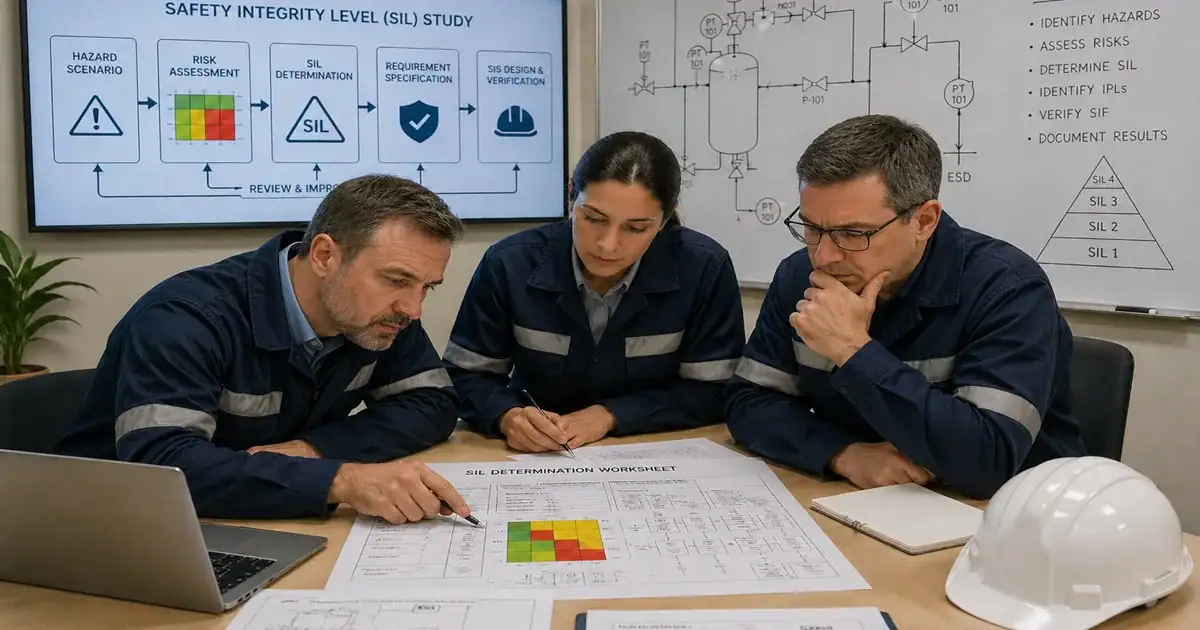

A SIL study is a functional safety assessment used to determine the Safety Integrity Level required for safety instrumented functions. It helps organisations understand how much risk reduction is needed, usually using methods such as LOPA, risk graphs or other structured risk assessment techniques.
SIL stands for Safety Integrity Level. It is used in high-risk sectors such as chemical processing, oil and gas, nuclear power, transport and manufacturing to specify the reliability required from safety functions that prevent or mitigate hazardous events.
SIL is governed by functional safety standards such as IEC 61508 and IEC 61511. These standards cover the safety lifecycle, from hazard identification and risk assessment through to design, validation, operation, maintenance and review.
Why SIL studies create actions
A SIL study does not usually end with the calculation alone. It often generates recommendations, design changes, verification tasks, maintenance requirements and follow-up actions that need to be assigned, tracked and closed out.
Those actions may relate to safety instrumented functions, proof testing, documentation, operating procedures, training, maintenance, or further engineering review. Managing them properly is important because a SIL assessment only supports risk reduction if the resulting actions are completed and evidenced.
The Concept of Safety Integrity Level
Key Components of SIL
- Probability of Failure on Demand (PFD): PFD measures the likelihood that a safety system
will fail to perform its required function when needed. Each SIL corresponds to a specific PFD range, with lower values indicating higher reliability.
- Risk Reduction Factor (RRF): RRF is the inverse of PFD, representing the risk reduction due to the safety function. For instance, a system with a PFD of 0.01 (SIL 2) has an RRF of 100, meaning it reduces the risk by a factor of 100.
- Safety Lifecycle: The safety lifecycle includes phases such as hazard and risk assessment, system design and implementation, operation and maintenance, and decommissioning, ensuring comprehensive safety management from conception to decommissioning.
- Functional Safety Standards: Standards like IEC 61508 and IEC 61511 provide guidelines for achieving SIL compliance, covering safety requirements specification, design, validation, and maintenance.
Using appropriate Action Tracking software can help to keep control of safety-critical actions and improve overall visibility of the processes involved in reducing risk.
Understanding Safety Functions
- Emergency Shutdown Systems (ESD): Designed to safely shut down a process or operation in case of an emergency, preventing accidents or minimizing their impact. For example, an ESD might automatically shut down a chemical reactor if it detects excessive pressure or temperature.
- Fire and Gas Systems (FGS): Detect fires or gas leaks and initiate appropriate actions such as activating alarms, shutting down equipment, or triggering fire suppression systems. These systems are vital in industries where flammable materials are handled.
- Safety Instrumented Systems (SIS): A broader category that includes systems designed to monitor process variables and take corrective actions to maintain safe operating conditions. SIS can include pressure relief systems, temperature control systems, and other automated safety measures.
- Pressure Relief Systems: These systems protect equipment and personnel by relieving excess pressure in vessels or pipelines. They often include pressure relief valves, rupture disks, and vent systems.
- Control Systems: Implement control loops to maintain process variables within safe limits. For example, a temperature control system might adjust the flow of coolant to prevent overheating in a reactor.
Determining SIL Requirements
- Hazard Identification and Risk Assessment: Identifying potential hazards and assessing risks using techniques like Hazard and Operability Study (HAZOP) and Failure Modes and Effects Analysis (FMEA).
- Risk Analysis: Quantifying risks in terms of frequency and severity to understand hazard impacts and the need for risk reduction.
- Risk Reduction Measures: Identifying appropriate measures, including non-technical solutions (e.g., administrative controls) and technical solutions (e.g., safety instrumented systems).
- SIL Determination: Using methods like risk graphs and Layers of Protection Analysis (LOPA) to assign SIL levels to safety functions based on required risk reduction (Fig 1).

Figure 1 - LOPA - Layers of protection
SIL Levels and Their Implications
- SIL 1: PFD 0.1 to 0.01. Provides basic risk reduction, requiring less stringent design and testing.
- SIL 2: PFD 0.01 to 0.001. Requires moderate risk reduction, with more rigorous design and testing.
- SIL 3: PFD 0.001 to 0.0001. Provides high risk reduction, necessitating stringent design, testing, and maintenance.
- SIL 4: PFD 0.0001 to 0.00001. Represents the highest risk reduction, requiring the most rigorous processes.
Practical Application of SIL
- Design and Engineering: Ensuring design compliance with the required SIL, selecting appropriate components, and designing fault-tolerant architectures.
- Validation and Verification: Rigorous testing under various conditions to ensure compliance with required SIL.
- Operation and Maintenance: Regular testing, inspection, and maintenance to ensure ongoing compliance.
- Documentation and Training: Comprehensive documentation and training to ensure proper operation and maintenance.
Case Study: SIL in the Process Industry
- Hazard Identification and Risk Assessment: A HAZOP study identifies potential hazards such as overpressure in a reactor. The risk assessment quantifies the potential impact and likelihood of an overpressure event.
- Risk Reduction Measures: The risk analysis might determine that existing control systems are insufficient, necessitating additional measures like an SIS.
- SIL Determination: Using methods like LOPA, the required SIL for the SIS is determined. Suppose the analysis indicates that the risk reduction needed corresponds to SIL 3. This means the SIS must achieve a PFD between 0.001 and 0.0001.
- Design and Engineering: The SIS is designed to meet SIL 3 requirements, involving the selection of reliable components and the implementation of fault-tolerant architectures.
- Validation and Verification: The SIS undergoes extensive testing to ensure it meets SIL 3 standards, including functional and scenario-based testing.
- Operation and Maintenance: A maintenance schedule is implemented to include regular testing and inspection of the SIS to ensure it continues to meet SIL 3 requirements.
- Documentation and Training: Detailed documentation of the SIS design, testing, and maintenance procedures is maintained, and personnel are trained in the operation and maintenance of the SIS.
Challenges and SIL Best Practices
- Complexity: Higher SIL levels require more complex designs and rigorous testing, making management challenging.
- Cost: Achieving higher SIL levels involves significant costs for design, testing, and maintenance, necessitating a balance between safety and cost.
- Regulatory Compliance: Ensuring compliance with standards like IEC 61508 and IEC 61511 requires ongoing effort.
- Human Factors: Human error can impact the effectiveness of safety systems, emphasising the need for comprehensive training and clear procedures.
Best Practices Include
- Early Involvement: Involving safety engineers early ensures safety requirements are integrated into the design from the beginning.
- Regular Reviews: Conducting regular safety reviews and audits helps identify potential issues and ensures ongoing compliance with SIL requirements.
- Continuous Improvement: Implementing a culture of continuous improvement helps organisations adapt to changing safety requirements and technological advancements.
- Stakeholder Engagement: Engaging all stakeholders ensures a comprehensive understanding of safety requirements and fosters a culture of safety.
SIL and ALARP
SIL determination sits within a broader framework of demonstrating that risks have been reduced to a level that is As Low As Reasonably Practicable (ALARP). LOPA is the most common quantitative method used to demonstrate ALARP and assign SIL levels, but the ALARP principle itself requires documented evidence that all reasonably practicable risk reduction measures have been considered and implemented. This is where action tracking becomes essential. The ALARP case is only defensible if every recommended measure can be shown to have been actioned, verified and closed out with evidence.
Action Tracking and SIL: What Software Do You Actually Need?
A common question after a SIL study is what software is required to manage the outputs. The answer depends on what you are trying to do.
For the SIL calculation itself, specialist tools like exSILentia, SILcalc or Sistema handle the quantitative assessment of safety instrumented functions against IEC 61508 and IEC 61511. These are engineering tools designed for the calculation phase.
What they don't do is effectively manage what happens next. A SIL study generates a list of actions, findings and recommendations. Each of those steps needs an owner, a due date, a completion record and an audit trail. That is an action tracking problem which needs a specialised action tracking solution.
A structured action tracking system gives you:
- A central register of all findings from the SIL study
- Named owners and due dates for every action
- Automatic alerts when actions are overdue
- A documented close-out record for each finding
- A complete audit trail that satisfies IEC 61511 functional safety management requirements
- Cross-study visibility, so HAZOP actions, LOPA actions and SIL verification actions all sit in the same system
For organisations running multiple SIL studies across different projects or sites, the difference between a spreadsheet and a structured action tracker becomes significant very quickly. Actions get lost, close-out evidence is inconsistent, and auditors have no single point of reference.
The Pisys Action Tracker helps process safety teams manage SIL study actions, HAZOP actions, LOPA actions and verification actions in one governed system. Each action can be assigned to an owner, given a due date, tracked through review stages and closed with supporting evidence and a full audit trail.
For a broader overview of how action tracking is used across audits, HSE, process safety, projects and operational risk, see our guide to action tracking.