
Audit and inspection action tracking is the process of recording, assigning, monitoring, evidencing and closing actions that arise from audit findings, inspections or reviews.
Audits and inspections are only valuable when their findings lead to verified action. Organisations may invest significant time in internal, regulatory or third-party audits, only for the resulting actions to remain unresolved for weeks or months.
This is usually a process problem rather than a people problem. Without a structured way to capture, assign, track and verify findings, ownership becomes unclear, evidence is lost and the same issues reappear during later audits.
For a wider overview, read our guide to the multiple uses of action tracking in business.
What is audit action tracking?
Audit action tracking gives each action a clear owner, due date, priority, status and evidence record. It helps teams move from identifying a problem to confirming that corrective action has been completed and verified.
Where inspections fit into audit and inspection action tracking
Audits and inspections are different activities, but both create actions that need to be managed through to close-out. An audit may identify a non-conformance against a standard, procedure or regulatory requirement. An inspection may identify a physical defect, unsafe condition, missing control or follow-up task.
In both cases, the action only becomes relevant when it is assigned to an owner, given a due date, supported by evidence and verified as closed. That is why audit action tracking often sits alongside inspection action management in HSE, quality and process safety systems.
For HSE, quality, process safety and compliance teams, this is important because an audit finding is only resolved when the action has been completed, reviewed and supported by evidence that stands up to scrutiny.
The gap between findings and resolution
Every audit generates findings. Some are minor observations, others are significant non-conformances that require urgent corrective action. In both cases, the same challenge applies: someone needs to own the finding, take action, and confirm the issue has been resolved.
Where this process is managed informally, through meeting notes, email chains or shared spreadsheets, the results are predictable. Actions get missed. Ownership becomes unclear. By the time the next audit comes around, the same findings reappear, and there is no reliable record of what was done in between.
The consequences go beyond internal inefficiency. In regulated industries, an inability to demonstrate that audit findings have been addressed can result in regulatory censure, failed certification, or increased scrutiny from insurers and clients. The problem is that there is no defensible evidence that the organisation addressed the issue.
Why audit traceability matters
In process safety, you need to do the right thing every time. You also need to demonstrate clearly and consistently what was done, why it was done, who approved it, and what evidence shows it was effective.
That’s what an audit trail is for. And when regulators, corporate assurance teams, JV partners, or internal technical authorities start asking questions, traceability is what separates “we think we’re safe” from “we can prove we’re in control.”
Auditors can get to the point very quickly - expect questions like:
- “Why is this safeguard considered adequate?”
- “Where did this decision come from?”
- “What changed this and who approved it?”
- “How do you know this action is actually complete?”
- “Show me the evidence.”
If finding the answers means searching through emails, spreadsheet versions or relying on individual memory, the process is not scrutiny-ready.
What scrutiny-ready action management looks like
We use the term 'Scrutiny' because not everything is a formal audit. Different stakeholders need different data and levels of detail, but we're outlining practices that will allow you to be prepared for whatever demands are made.
It’s about building a defensible chain of evidence from hazard to control to verification, so that a third party can follow the logic without interpretation.
The three elements of defensible traceability
A strong approach has three pillars:
1) Audit trail: who, what and when
A credible audit trail captures:
- Who created, edited, or approved something
- What changed, and ideally why
- When it happened
- Supporting evidence attached.
That matters because regulators and independent auditors are often evaluating governance, not just technical content.
Read more about how effective action tracking can improve leadership and governance
2) Traceability
Traceability connects:
- Hazard, scenario, or major accident hazard
- Risk assessment outputs such as HAZOP, LOPA, Bowtie, QRA
- Required safeguards or barriers
- Actions and changes including MOC
- Verification and effectiveness evidence
- Ongoing sustainment such as testing, inspections, competency
Without that link, you can complete tasks yet still fail to demonstrate control.
3) Evidence packs: prove it
For safety-critical items, evidence is key. The goal is an evidence bundle appropriate to the action type.
Typical examples include:
- Approved drawings such as P&IDs, cause and effect, layouts; calculations; datasheets
- Test, commissioning, and proof test records such as FAT, SAT, loop checks
- Procedure revisions plus training and competency records
- Inspection findings plus photo or field verification
- MOC approvals and readiness or handback documentation
What structured audit action tracking delivers
When audit and inspection findings and associated actions are captured in a dedicated action tracking system, the process changes in several important ways.
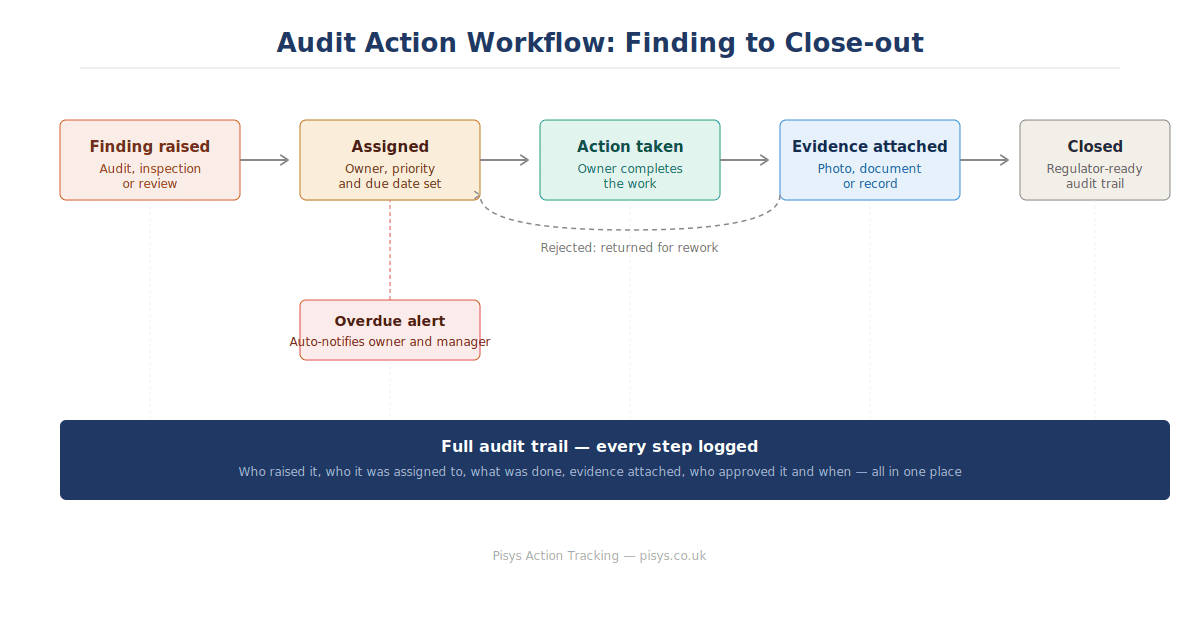
Each action has a clear owner, a priority level, and a target completion date. There is no ambiguity about who is responsible or when the action is due. The person assigned to the action receives notification, can update progress, and can attach supporting evidence such as photographs, revised procedures and training records directly to the action record.
This matters particularly for verification. Marking an action as complete is not the same as confirming it has been effective. A structured system supports a verification stage where a responsible manager or auditor can review the evidence and confirm that the action has genuinely been completed, not just closed on paper.
The audit trail this creates is also significant. When a regulator or external auditor asks how a previous finding was resolved, the organisation can provide a clear, chronological record: when the associated action (or actions) was raised, who it was assigned to, what steps were taken, what evidence was attached, and when it was verified as closed. This level of transparency builds confidence and reduces the time spent preparing for external scrutiny.
A practical traceability model
Here’s a repeatable way to structure records so you can answer regulator-style questions quickly:
1. Define the risk context up front
- What hazard scenario does this relate to?
- What is the consequence being controlled?
- What safeguard intent is required?
2. Create action records that are testable
- Clear deliverable
- Acceptance criteria
- Required evidence types
- Owner, verifier, due date, risk level
3. Link to the source and to change control
- HAZOP node, deviation, action ID; audit finding; incident recommendation, etc.
- MOC reference where relevant
4. Capture decision making
- Why this solution?
- What alternatives were considered?
- What assumptions does it rely on?
5. Verify effectiveness, not just completion
- Independent verification appropriate to risk
- Evidence confirms the safeguard intent is achieved in the field
6. Close with a defensible statement
“Closed because X evidence demonstrates Y safeguard intent, verified by Z on DATE.”
This is exactly the kind of narrative auditors look for.
Common failure modes
Evidence cannot be found
Fix: require evidence attachments at closure, not links to personal drives or inboxes.
Approval responsibility is unclear
Fix: enforce role-based approval steps (for example TA, Process Safety, Operations) and record them automatically.
Actions lose their original context
Fix: keep the link to the original hazard or finding and safeguard intent so closure decisions remain understandable months later.
Change control and actions are disconnected
Fix: cross-link MOC, actions, and risk assessment so the full chain is visible.
Spreadsheets fail under governance pressure
Fix: if the work is high governance (major hazards, multi-site programmes, JV visibility), track it in a system designed for audit trails, access control, and version integrity—not parallel edits and emailed copies.
Supporting Repeat and Cyclical Audits
Most organisations conduct audits on a regular cycle: annual management system reviews, monthly site inspections, quarterly compliance checks. One of the practical challenges with cyclical auditing is ensuring continuity between cycles. When previous findings are accessible and clearly linked to their associated actions, auditors can quickly assess whether actions were effective and whether issues have recurred.
This turns the audit process into a genuine learning loop. Organisations can identify which areas generate persistent findings, which types of corrective action tend to succeed or fail, and where the root causes of non-conformance lie. Without action tracking, this kind of analysis requires significant manual effort. With it, the data is already there.
Consistency across audit cycles also reduces the administrative burden on audit teams. Preparing for a review no longer means chasing down information from multiple people and systems. The action history is available, searchable, and up to date.
Coordinating Actions Across Functions
Audit findings rarely fall neatly within the remit of a single team. A safety inspection might identify a maintenance issue, a training gap, and a procedural deficiency, each of which belongs to a different function. An environmental audit might require input from operations, engineering, and procurement before a corrective action can be fully implemented.
Action tracking supports this kind of cross-functional coordination by making dependencies visible and keeping all parties aligned. Each team can see their own actions in context, understand how their contribution fits into the wider picture, and update progress without relying on informal communication. At the same time, whoever is overseeing the audit response can see the full picture at any time, without needing to chase individual updates.
In environments involving external organisations like contractors, suppliers and joint venture partners this coordination becomes more complex. Controlled access features allow external parties to view and update the actions relevant to them without seeing unrelated or confidential information. This protects commercial sensitivity while maintaining the transparency needed for effective collaboration.
Dashboards and management oversight
For managers responsible for compliance across a site, a business unit, or an entire organisation, the challenge is usually not having information in a usable form. Action tracking systems that surface audit data through dashboards and KPIs give leaders a real-time view of compliance performance without requiring them to read through individual audit reports.
For a system that holds up under scrutiny, track indicators that emphasise governance:
- Percent of safety-critical actions closed with complete evidence packs
- Overdue high-risk actions and escalation adherence
- Re-open rate after verification
- Average age of open regulatory or assurance actions
- Traceability completeness, meaning actions linked to hazard, barrier, and verification
This enables leaders to intervene where needed, recognise where teams are performing well, and make informed decisions about where to focus improvement effort.
When this data can be integrated with wider business intelligence tools, the picture becomes richer. Combining audit action data with operational performance metrics or incident trends allows organisations to explore correlations and identify where systemic issues may be driving both compliance failures and operational problems.
From compliance activity to continuous improvement
The organisations that get the most from their audit and inspection processes are those that treat findings as opportunities to improve. Action tracking is what makes this possible in practice. It closes the loop between identification and resolution, creates the evidence needed to demonstrate compliance, and generates the data needed to improve the process itself over time.
For businesses operating in complex regulatory environments, or simply for those that want their audits to mean something, a structured approach to managing audit actions is not optional.
Regulatory scrutiny readiness is an outcome of using the correct tools in a disciplined way.
- A defensible audit trail;
- Traceability that explains decisions;
- Evidence that proves effectiveness;
- Governance that demonstrates accountability.
Conclusion
Effective audit and inspection action management closes the loop between finding, action, evidence, verification and final close-out.
When those are built into your process, scrutiny becomes routine. Pisys Action Tracker helps teams manage audit actions, inspection findings, HSE actions and process safety recommendations with clear ownership, due dates, evidence, review stages and a complete timestamped audit trail from creation to verified close-out.