

Published: 29 January 2026
Updated: 12 July 2026
Offshore operations take place in some of the most demanding environments in the energy sector. Semi-submersible vessels, in particular, operate at the intersection of marine engineering, offshore production and environmental forces, where stability, safety and operational integrity are closely linked. Errors can have serious consequences for personnel, assets and the environment. As offshore systems become more complex and operational tolerances tighter, simulation-based training has become a critical tool for preparing crews to operate safely and effectively.
Simulation allows offshore personnel to experience realistic operational scenarios in a controlled environment. Crews can practise routine tasks, abnormal situations and emergency response without exposing people or assets to risk. For semi-submersible vessels, where behaviour is influenced by ballast configuration, environmental conditions and operational state, simulation provides training value that cannot be replicated through classroom instruction alone.
The Operational Complexity of Semi-Submersible Vessels
Semi-submersible vessels achieve stability through submerged pontoons and columns, enabling operations in deep water and harsh environments. While this design offers significant advantages, it also introduces complexity. Stability is influenced by ballast distribution, loading conditions, mooring or dynamic positioning systems, and changing environmental forces such as waves, wind and currents.
Marine operations such as ballasting, deballasting, station keeping, load transfers and preparation for weather events require precise coordination and careful decision-making. Many of these activities are infrequent or highly situation-specific, making them difficult to practise safely during live offshore operations.
Why Live Drills Are Not Enough
Live drills have an important role in offshore training. They validate physical procedures, test equipment readiness, and reinforce team coordination in the actual environment. But for semi-submersible operations, they have significant limitations that simulation is uniquely placed to address.
High-consequence scenarios cannot be rehearsed on live assets
Events such as progressive flooding, major mooring failure, blackout during adverse weather, or rapid loss of stability cannot be safely induced on an operational vessel. These are precisely the scenarios where crew readiness matters most, and precisely where live drills are not an option.
Rare events cannot be practised frequently enough
The value of rehearsal comes from repetition. On a live asset, even minor abnormal events occur infrequently. Crews may go months or years without encountering certain scenarios, meaning that when they do occur, the response relies on memory of training rather than recent practice.
Environmental conditions cannot be controlled
A live drill takes place in whatever conditions exist at the time. A simulator can replicate any sea state, any wind speed, any combination of environmental forces, allowing crews to practise the scenarios that are hardest to manage, not just those that happen to be available.
The consequences of error during a drill are real
On a live asset, a mistake during a ballast drill or a mooring exercise has real consequences. This limits how far drills can push crews and how realistic the scenarios can be. In a simulator, there are no such constraints.
Simulation does not replace live drills. It addresses the scenarios that live drills cannot reach and provides the frequency of practice that live drills cannot deliver.
What Trainees Experience
Simulation-based training for semi-submersible vessels uses detailed models to replicate vessel behaviour, ballast systems, environmental forces and control interfaces. Trainees interact with systems that closely resemble those used offshore, allowing them to practise realistic tasks and scenarios.
The simulator responds dynamically to trainee actions. Ballast transfers affect trim and stability in real time. Environmental conditions evolve. System failures cascade in ways that reflect real vessel behaviour. This dynamic response is what makes simulation effective: trainees see the consequences of their decisions as they make them, building the kind of intuitive understanding of vessel behaviour that cannot be developed through theory alone.
Ballast Control and Stability Management Training
Ballast control is one of the most critical aspects of semi-submersible operations. Incorrect ballast transfers or poor awareness of stability margins can rapidly compromise vessel safety. Simulation allows crews to practise ballast operations under a wide range of conditions, including changing loads, environmental influences and system failures.
Through repeated practice, trainees build familiarity with how the vessel responds to ballast changes and learn to recognise early warning signs of developing stability issues. This experience supports safer decision-making and more effective intervention during real operations.
Mooring and Dynamic Positioning
Maintaining station is a continuous operational requirement for semi-submersible vessels, and a significant source of risk when things go wrong. Mooring systems and dynamic positioning systems each present distinct training challenges.
For moored vessels, crews must understand the interaction between mooring line tensions, vessel position, environmental loading and the consequences of line failure or degradation. The response to a single mooring line failure differs from the response to multiple failures, and both require prompt, coordinated action that benefits from prior rehearsal.
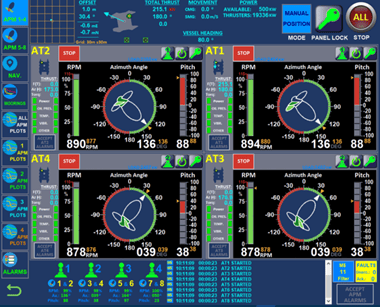
For dynamically positioned vessels, the consequences of DP failure in certain conditions can be severe and can develop rapidly. Simulation allows crews to practise responses to thruster failures, power system faults, reference system failures and position excursion events, scenarios that are impossible to rehearse safely on a live asset.
Blackout and Power System Failures
A blackout on a semi-submersible vessel is one of the most demanding emergency scenarios crews can face. The simultaneous loss of power to propulsion, ballast pumps, DP systems and control room instrumentation creates immediate and compounding challenges. Station keeping may be compromised. Ballast systems become unavailable at the moment they may be needed most. Communication systems may be affected. The crew must respond quickly, correctly, and in coordination across multiple roles.
This is a scenario that cannot be safely rehearsed on a live asset, but one where the quality of the crew's response directly affects safety outcomes. Simulation allows blackout scenarios to be practised in full, including power restoration sequences, manual overrides, and coordination between the control room and engineering teams, giving crews the familiarity and confidence that only repeated practice can build.
Preparing for Abnormal and Emergency Scenarios
Some of the most serious offshore incidents occur rarely, but demand immediate and effective action when they do arise. Beyond blackouts and mooring failures, these include flooding and loss of watertight integrity, loss of stability due to ballast system failure or incorrect operation, vessel collision or allision, extreme weather escalation beyond planned operational limits, and fire or gas events coinciding with degraded marine systems.
Scenarios like this cannot be safely rehearsed offshore. Simulation allows crews to rehearse these situations in detail. Teams can practise emergency procedures, coordination between roles and prioritisation of actions under pressure. This preparation improves confidence and readiness, reducing the likelihood of hesitation or error during real emergencies.
Integrating Marine and Operational Systems
Semi-submersible vessels often support complex drilling, production or construction activities. Marine systems cannot be managed in isolation from these operations. Decisions made to maintain stability or positioning may affect operational systems, and operational changes can influence vessel behaviour. Communication is vital and simulators should support all available systems as realistically as possible, including radio, PA and telephone, to reflect the coordination demands of real operations.
Developing Teamwork and Non-Technical Skills Offshore
Offshore safety depends not only on technical competence but also on effective communication, coordination and situational awareness. Simulation-based training provides a realistic environment for developing these non-technical skills.
Marine OIMs and ballast control operators do not work in isolation. Their decisions affect and are affected by what is happening across the vessel. During simulated scenarios, teams can practise information sharing, decision-making and workload management under pressure. Instructors can observe interactions and facilitate structured debriefs, helping crews reflect on performance and identify opportunities for improvement.
Online and Cloud-Based Simulation for Offshore Training
Advances in digital technology have expanded access to offshore simulation training. Many simulators can now be delivered online through cloud platforms, allowing remote access without the need for dedicated training facilities. This approach supports flexible scheduling and pay-per-use delivery models.
For offshore operations, online access enables refresher training between rotations, preparation for specific tasks or campaigns, and rapid response to changes in procedures or operating conditions. This flexibility supports continuous competence development rather than reliance on infrequent training events, which is particularly important for maintaining readiness for the rare but high-consequence scenarios that simulation is best placed to address.
Implementation Considerations
It is vital that the modelling behind semi-submersible simulators accurately reflects vessel characteristics, ballast systems and operating procedures. Generic models provide substantial training value, but asset-specific models allow crews to practise on a virtual replica of the vessel they operate, producing more direct transfer of learning to real performance. Like all simulators, it may be necessary to update the model if the target environment or vessel configuration changes.
Conclusion
Semi-submersible vessels operate in environments where stability, safety and operational performance are tightly interconnected. Live drills have a role in maintaining readiness, but they cannot reach the scenarios that matter most: the rare, high-consequence events where crew competence has the greatest effect on outcomes.
Simulation addresses that gap directly. It allows Marine OIMs, ballast control operators and their teams to practise the full range of scenarios they may encounter, from routine ballast operations to blackouts, mooring failures and major stability events, in a realistic, repeatable and risk-free environment.
To find out more, explore the Pisys range of Semi-submersible Training Simulators. We're also extremely proud of our Double Derrick semi-submersible training simulator, which helps address some of the unique MEMIR issues around the double-derrick configuration.
Both simulators are part of our range of MEMIR/Operations Training Simulators.