

If your organisation already has a hot work permit process in place, you're managing the basics: authorisation, hazard identification, fire watch and post-work inspection. But traditional controls rely on visual checks and manual oversight — and visual inspection has limits. Heat doesn't always show itself until it's too late.
Thermal imaging technology offers a measurable upgrade to the standard hot work permit process. By making heat visible before, during and after work, it closes the gap between procedure and practice — turning a compliance exercise into a verifiable safety record.
For a full overview of what a hot work permit must contain, read our hot work permit requirements guide.
Permits turn a potentially dangerous task into a controlled, auditable safety process. However they are not a guarantee of safety on their own since they depend on correct execution, oversight and recorded evidence throughout the work lifecycle. Learn more Permit to work systems and why they are important.
Thermal Imaging: Sharpening Risk Awareness in Hot Work
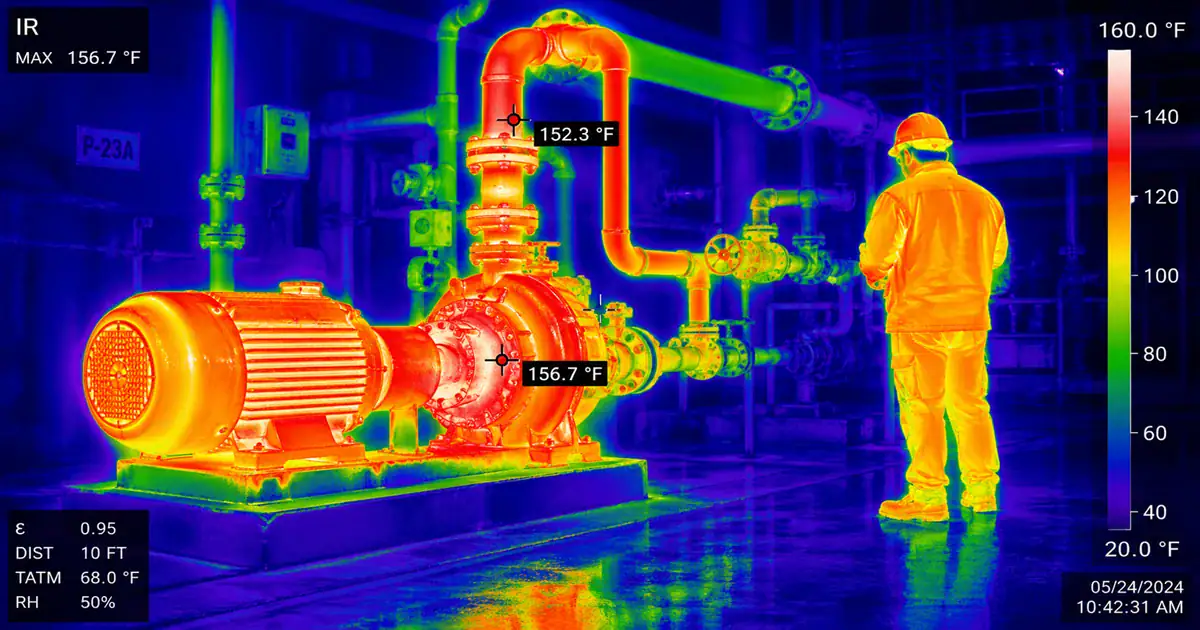
Traditional hot work controls rely on visual inspection and manual fire watches, which are essential but inherently limited. Thermal imaging technology - a technique that visualises heat signatures through infrared radiation, offers insight into what the human eye cannot see.
When used before, during and after hot work activities, thermal imaging:
- Detects incipient hot spots that may precede fire ignition
- Validates cooling and dissipation of residual heat post-work
- Supports documented evidence of safe conditions for permit handback
- Augments fire watch duties with measurable data, not just visual checks
These capabilities are particularly valuable where hidden heat build-up or conductive heating can persist beyond the visible work zone, situations where traditional inspection may miss the latent risk.
Thermal imaging enhances the diligence process, giving teams a data-informed view of thermal risk during critical moments.
Embedding Thermal Imaging Within the Permit Lifecycle
To maximise value, thermal imaging should be integrated directly into the Hot Work Permit process, not treated as an optional add-on.
In a strategic workflow, thermal imaging can be used in:
- Pre-Work Baseline Scans -Identify existing heat sources before hot work begins.
- Active Monitoring - Validate fire watch inspections with heat maps and real-time images.
- Post-Work Verification - Confirm that no dangerous heat remains before permit handback.
- Compliance Evidence - Attach thermal images directly to the permit history as part of audit records.
By linking thermal imaging outputs with the permit’s digital record, organisations create a verifiable evidence trail that strengthens assurance and demonstrates proactive risk control.
Pisys Permit to Work: Enabling Evidence-Driven Safety
Pisys’ Permit to Work platform supports a modern, digital approach to hot work risk management by allowing teams to:
- Issue and approve hot work permits digitally from any device, anywhere.
- Attach thermal imaging outputs and documentation directly to permits.
- Track fire watch status and sign-offs in real time.
- Maintain complete audit trails that integrate thermal evidence with authorisations and risk assessments.
- Monitor simultaneous operations (SIMOPS) and conflict risk across work areas.
This evidence-driven approach helps organisations move beyond checklist compliance towards operational assurance and confident risk leadership.
From Compliance to Confidence
For senior leaders and safety professionals, the question isn't whether a Hot Work Permit exists, but whether the organisation can prove it worked when it mattered. Thermal imaging, integrated with a robust digital permit system delivers that proof.
It enhances traditional controls with measurable insight, strengthens accountability and helps close the gap between procedure and practice. When combined with Pisys’ digital permit framework, thermal imaging becomes part of a broader, transparent safety ecosystem, one that equips teams to make better decisions, faster.
Fire Risk Control Must Evolve with Evidence
Hot work remains indispensable in industrial operations, but the hazards it introduces require clear authorisation, real-time insight and documented processes.
By integrating thermal imaging into the permit lifecycle and leveraging digital tools like Pisys Permit to Work, organisations reinforce:
- Safer execution of high-risk tasks
- Greater confidence in risk controls
- A culture of measurable safety performance
- Stronger governance and compliance evidence
In an era where visibility drives better decisions, heat maps and thermal evidence should be part of every modern hot work strategy.
At Pisys, we’ve helped companies worldwide replace outdated paper systems with flexible, secure, and scalable digital solutions. Our Permit to Work software supports all major permit types including hot work, confined space entry, electrical isolation, and more, within a single platform.
