


Additional Near Miss Categories: Using a Continuum to Improve Learning
Near miss reporting is a critical part of effective health and safety management. It provides early insight into hazards, weaknesses in controls and emerging risks before harm occurs. However, the value of near miss reporting depends on how clearly events are categorised and understood.
A common limitation in many reporting systems is that all events are grouped together under a single “near miss” label. In reality, events differ significantly in terms of exposure, severity and learning value. Viewing these events along a continuum allows organisations to interpret risk more accurately and respond more effectively. in a 2013 article Chuck Pettinger suggests that near-miss events should be further categorised as they appear along a continuum.
A practical continuum places events in the following order: Error Likely, Good Catch, Near Miss, and Near Hit.
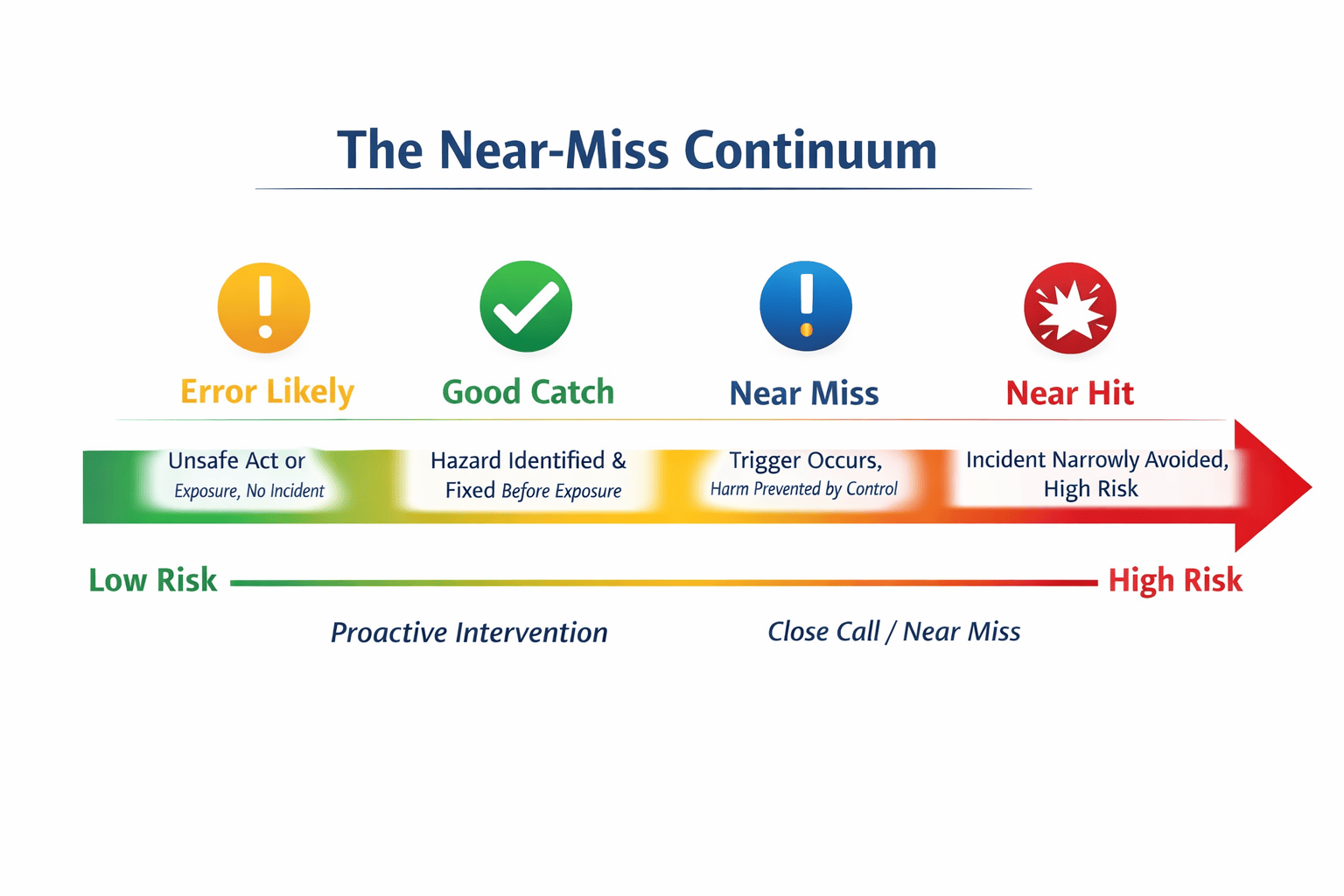
Understanding the Near-Miss Continuum
The near-miss continuum reflects how close an event came to causing harm and how much reliance there was on controls, timing or chance. Each category represents a different level of exposure and risk, and therefore requires a different type of response.
Positioning events correctly on this continuum helps organisations prioritise effort, focus learning and avoid treating all reported events as equal. Let's look at the individual categories.
Error Likely: Conditions Where Harm Could Easily Occur
An Error Likely event describes a situation where a person is exposed to a hazard and an error or failure could reasonably occur, but no triggering event happens.
Examples include walking beneath a suspended load, placing hands close to moving machinery, working near an unprotected edge, or operating equipment with missing safeguards without an incident occurring.
In these situations, injury is avoided due to timing, conditions or chance rather than robust controls. Error likely events indicate that risk is present and exposure exists, even though no immediate outcome occurs.
These events sit at the start of the continuum because they represent the first meaningful exposure to harm, and they often highlight weaknesses in planning, supervision or risk awareness.
Good Catch: Hazard Identified Before Exposure Escalates
A Good Catch occurs when a hazard is identified and corrected before it leads to harm. Unlike error likely events, a good catch typically involves recognition and intervention before a triggering event occurs.
Examples include identifying a missing guard before equipment is started, spotting an incorrect isolation prior to work, noticing a damaged access ladder, or identifying poor housekeeping before an area is used.
Good catches sit after 'Error likely' events on the continuum because they represent active intervention that prevents escalation. They are valuable because they demonstrate awareness and proactive behaviour.
Patterns in good catch reporting can reveal systemic issues such as maintenance gaps, unclear responsibilities or ineffective inspections.
Near Miss: Exposure Occurs, but Controls Prevent Harm
A Near Miss sits further along the continuum. In these events, exposure to a hazard occurs and a triggering event may take place, but injury or damage is prevented by an existing control rather than by luck.
Examples include a dropped object being stopped by a toe board, a fall being arrested by a harness, a vehicle striking a barrier, or an automatic shutdown preventing equipment damage.
Near misses confirm that a real failure occurred, even though harm was avoided. They demonstrate that controls worked, but also show that those controls were relied upon, often as a last line of defence.
These events provide strong learning opportunities and often highlight where earlier controls could be strengthened.
Near Hit: Harm Narrowly Avoided
At the most serious end of the continuum are Near Hits. These are events where injury or damage was narrowly avoided, often due to last-second reaction or chance rather than effective controls.
Examples include a dropped object narrowly missing a worker, a vehicle stopping just short of collision, a tool falling past someone’s head, or an unexpected release of energy that does not result in injury.
Near hits represent the highest level of risk and urgency. The difference between a near hit and a serious incident is often minimal, and these events should trigger immediate attention and robust follow-up.
Why This Distinction Matters
When error likely events, good catches, near misses and near hits are all recorded simply as “near misses”, important differences in risk are lost. High volumes of low-risk events can obscure fewer but far more serious warnings.
Clear differentiation allows organisations to respond proportionately. Error likely events highlight exposure risk. Good catches reinforce proactive behaviour. Near misses drive control improvement. Near hits justify formal investigation and senior oversight.
This ensures attention and resources are directed where they have the greatest preventative impact.
Using Additional Descriptors to Support the Continuum
Additional near miss descriptors provide the structure needed to apply the continuum consistently.
Descriptors help clarify proximity to harm, potential injury severity, energy source involved and body parts at risk. Together, they help determine where an event sits on the continuum and how urgently it should be addressed.
This reduces reliance on subjective judgement and improves consistency across reports and teams.
Descriptors such as proximity to harm help distinguish good catches from near hits by clarifying whether anyone was exposed and how close the event came to causing injury.
Potential injury severity descriptors help assess what could realistically have happened if circumstances were slightly different.
Energy source descriptors add further context, identifying whether gravitational, electrical, mechanical or vehicle energy was involved and increasing understanding of consequence potential.
Capturing body parts at risk descriptors further strengthens understanding of where events sit on the continuum. A good catch involving potential foot injury carries different implications from an error likely event involving head or torso exposure.
Together, these descriptors turn the continuum from a concept into a practical reporting tool. Over time, this information helps identify patterns of exposure that may point to weaknesses in design, guarding or procedures.
Using the Data to Understand Risk
Near miss reporting should not be judged by volume alone. A high number of good catches does not represent the same level of risk as a small number of near hits.
Using a continuum-based approach shifts focus from how many events occurred to what type of events occurred. This supports more mature, risk-based safety management and clearer decision-making.
Supporting Proportionate Action and Learning
Clear categorisation supports proportionate follow-up. Not every event requires the same level of investigation or escalation.
Error likely events may require review of planning and supervision. Good catches may prompt local corrective action and positive feedback. Near misses may justify control improvements. Near hits may require formal investigation and management review.
This approach maintains engagement in reporting while ensuring serious warnings are not overlooked. A robust action tracking system should allow all data relevant to the near miss to be entered, and relevant mitigating actions to be created and assigned. Mersen, a leading global producer of Carbon Insulation selected the Pisys Action Tracker to record near-misses at its Scottish facility at Holytown (read the case study)
Summary
Near miss reporting is most effective when it recognises that not all events carry the same level of risk. Placing Error Likely, Good Catch, Near Miss and Near Hit clearly along a continuum improves learning, prioritisation and prevention.
By combining these categories with additional near miss descriptors, organisations gain clearer insight into risk and can intervene earlier to prevent serious incidents.
Near miss reporting should help organisations understand how close they came to harm, and what that means for managing risk going forward.

